American Express Q3 Earnings: Network Volumes Jump 8%, Credit Loss Provisions Drop 23%
Seeking Alpha · October 23, 2026
Key takeaways
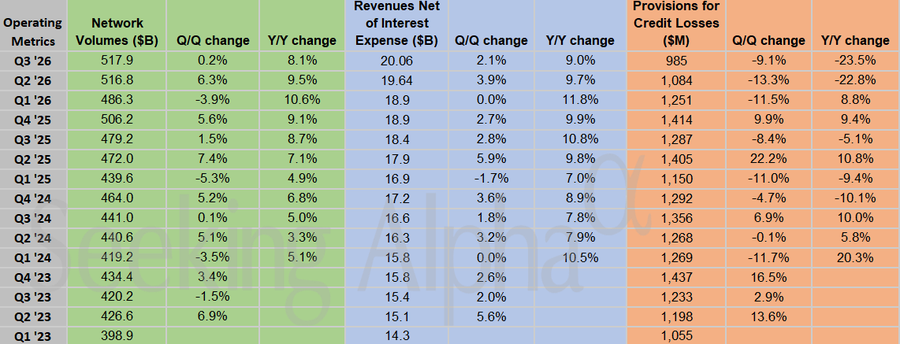
- American Express Q3 network volume grew 8% year-over-year, driven by continued strong card spending from its premium customer base.
- Provisions for credit losses fell 23% year-over-year, suggesting Amex sees lower default risk among its cardholders than it did last year.
- The results point to resilience among Amex's affluent spender base even as other lenders report rising consumer credit stress.
What Happened
American Express just posted its Q3 numbers, and the headline stats tell a pretty clean story: network volumes — basically the total dollar amount running through Amex cards — climbed 8% year-over-year, while provisions for credit losses fell 23% compared to the same quarter last year.
In plain English: people and businesses are swiping their Amex cards more, and the company is setting aside significantly less money to cover potential loan defaults. That combination is usually a green flag for a credit card company's balance sheet.
Why the Numbers Matter
Network volume is the lifeblood of Amex's business model. Unlike banks that mostly profit from interest on loans, Amex makes a big chunk of its money from the fees merchants pay every time a cardholder uses an Amex card. More spending equals more fee revenue, full stop. An 8% jump suggests Amex's premium cardholder base — think frequent travelers, small business owners, and high-spend consumers — kept opening their wallets even as broader consumer spending data has looked choppier elsewhere.
The credit loss provision drop is arguably the more interesting data point for anyone watching the health of the American consumer. Provisions are essentially a company's prediction of how much debt won't get paid back. When that number falls 23%, it signals Amex's models see less risk of cardholders defaulting than they did a year ago. That's notable because several other lenders have spent 2025 and 2026 bracing for rising delinquencies.
What It Says About Amex's Customer Base
Amex has long leaned into a strategy of courting affluent, lower-risk spenders through premium cards like the Platinum and Gold lineups, charging steep annual fees in exchange for travel perks and lounge access. This quarter's numbers look like a vindication of that playbook — the company's customer base appears more resilient to economic pressure than the average cardholder, which helps explain why credit losses are trending down even as some competitors report the opposite.
What to Watch Next
Investors will be watching whether this spending growth holds up through the holiday shopping season, typically Amex's biggest volume quarter. Any softening in travel and entertainment spending — categories where Amex over-indexes — would be the first sign of cracks. For now, though, the combination of rising volume and falling risk provisions points to a company firing on both cylinders heading into year-end.
Why it matters
Amex's earnings are often read as a bellwether for high-income consumer spending, so an 8% volume jump paired with falling credit loss provisions suggests that segment of the economy is still spending confidently. For investors and anyone watching consumer credit trends, it's a useful counterpoint to more cautious signals from other lenders.
Want deals on what you love?
Val finds local offers matched to your interests — free to start.
Meet Val